
Amidst escalating tensions in West Asia, India strongly condemns the recent attacks on energy infrastructure, warning of further destabilisation to the already uncertain global energy market.

Both sides have now revealed a preference for escalation over strategic defeat, and each new provocation narrows the space for the next pause. The Touska seizure, Iran's refusal to negotiate under blockade, Israel's strikes on Iranian oil infrastructure -- all of these add up to an increasingly untenable situation. This makes the wild card -- Trump and his motormouth -- more consequential than ever, notes Prem Panicker in his must read blog on the Iran War.

People across Kashmir have donated generously to Iran, which has been ravaged by war. Donations included cash, gold, silverware, and copper utensils. A woman even donated gold kept as a memento of her husband, who died 28 years ago. The Iranian Embassy in New Delhi has expressed its gratitude for the support.

US President Donald Trump has shared an article suggesting that the option of enforcing a naval blockade was available in the context of Iran, as peace talks ended in a stalemate in Islamabad after differences of opinion arose between the two parties on the Strait of Hormuz and Iran's nuclear capacities.

Iranian Supreme Leader Ayatollah Ali Khamenei has been killed in a US-Israeli attack, sparking celebrations in Iran and raising questions about the future of the regime.

In a clear message to international observers, the strategic site was pointedly "described as "the tip of the iceberg" regarding the nation's hidden arsenal.

Israel's Defence Minister Israel Katz has stated that Israel is prepared to escalate military action against Iran, pending approval from the United States. This comes as US President Donald Trump says he would not use nuclear weapons in any conflict with Iran, while also claiming the US has 'total control' over the Strait of Hormuz.

India has expressed strong concerns over attacks on commercial ships in the Strait of Hormuz, citing its importance to India's energy and economic security. Ambassador Yojna Patel highlighted the need to respect international law and ensure the safety of seafarers, while also addressing broader Middle East issues including the situation in Gaza and Lebanon.

Karex, the Malaysian company that makes roughly one in five of the world's condoms -- about five billion a year, supplying Durex and Trojan among others -- announced this week that it is raising prices by up to 30 percent. The reason is the Strait of Hormuz.

'In a volatile global market, India is pursuing a low-risk, low-return policy, akin to a SIP -- slow, steady investment.' 'Pakistan is following a high-risk, high-return policy.'

Congress leader Shashi Tharoor discusses India's role in the US-Iran peace talks taking place in Islamabad, emphasising the importance of peace over competition with Pakistan and highlighting India's regional interests.

Iran cannot participate in the 2026 World Cup after co-host the US launched airstrikes alongside Israel, Sports Minister Ahmad Donyamali said on Wednesday.
Iranian President Masoud Pezeshkian maintained a stance of defensive necessity, noting that Tehran is "forced to retaliate to attacks" but clarified that this does not imply a dispute with neighbouring countries

The clock on the ceasefire is running out. But everyone's already whispering about round two, possibly as soon as this weekend.
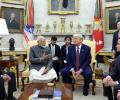
Prime Minister Narendra Modi and US President Donald Trump discussed the Middle East crisis, with a focus on the Strait of Hormuz.
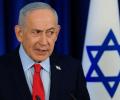
Benjamin Netanyahu declares that the joint Israel-US campaign is successfully 'crushing' Iran, eliminating existential threats and weakening the regime's regional influence.

Trump's remarks marks one of the most direct rebukes yet from Washington to its allies over their refusal to support US-led military operations in Iran and over the energy crisis triggered by disruptions in the Persian Gulf.

'Strikes into the Gulf countries are proof that the security guarantees offered by the US are ineffective and that the Gulf countries cannot rely on American security assurances for their safety.'

Trump added that the United States would assist in managing the traffic buildup in the Strait of Hormuz.

Tensions escalated dramatically on March 5, 2026, as the United States and Israel launched coordinated strikes on Iran, triggering retaliatory explosions across Tehran, Sanandaj, and beyond.
Amid escalating tensions, Iranian Deputy Foreign Minister Saeed Khatibzadeh declares Iran's unwavering commitment to a 'heroic nationalist defence' against perceived American and Israeli aggression, vowing to resist what he calls an 'invasion' to the very end.

'The next two to three weeks will not be decided in Washington.' 'They will be decided in Tehran, in whatever calculation Iran makes about the costs of continued resistance against the costs of appearing to have yielded.'

For that to happen America does not have to lose. It only has to do the right thing, asserts Aakar Patel.

Millions of soccer fans in the world's two most populous nations may not be able to watch the World Cup that starts next month, due to a deadlock over broadcast rights in India and no official decision in China.

The Cabinet Committee on Security (CCS) has reviewed the evolving situation in West Asia, directing departments to assist Indian nationals affected by recent developments and emphasizing the need for dialogue and diplomacy.

White House Press Secretary Karoline Leavitt on Tuesday said that the United States has not ruled out the option of sending troops on the ground in Iran and that military operations in the Persian Gulf nation would end once the objectives of Operation Epic Fury are achieved.

US defence officials confirmed that an F-35 did perform an emergency landing after an Iranian surface-to-air missile (SAM) barrage, with the pilot safe and an investigation underway.
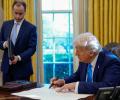
White House Press Secretary Karoline Leavitt noted that progress has been made in the Geneva talks with Iranian authorities, but the two nations stand 'far apart' on certain issues.

Amidst escalating tensions in West Asia, Russian President Vladimir Putin is actively calling for de-escalation and political resolution, engaging with Iranian and US counterparts to navigate the complex conflict landscape.

Pakistan is set to host face-to-face talks between the United States and Iran, aiming to solidify a fragile ceasefire and prevent further conflict in West Asia. The discussions will focus on a long-term peace arrangement, including sanctions relief, regional security, and Iran's nuclear program.

Israel will continue its offensive in South Lebanon aimed at neutralising the threat from Hezbollah, which is backed by Iran.
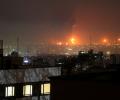
Israeli PM Benjamin Netanyahu has affirmed that the United States and his administration have achieved nearly total dominance over Iranian airspace following a series of coordinated military strikes.

The escalating conflict involving the U.S. and Israel with Iran has led to widespread disruption in the world of sports, with events postponed, travel plans thrown into chaos, and athletes seeking asylum.

Trump also called upon China, France, and Japan, among others, to send ships to the Strait of Hormuz.

The Kuwaiti Defence Ministry said all crew members of the crashed aircraft ejected safely and were taken to a hospital for medical check-ups.

Iran has issued a defiant response to United States President Donald Trump's claims regarding the conclusion of hostilities, asserting that it alone will 'determine' the end of military actions against American and Israel targets.

The United States used an array of weapons in the strikes conducted against Iran as part of Operation Epic Fury on Saturday -- which included artificial intelligence services from Anthropic, according to a report by Reuters.

Trump also brushed off criticism of his expletive-laden references to causing destruction in Iran if they failed to make a deal to end the war.

The Wrestling Federation of India has appointed three foreign coaches and a High Performance Director to enhance national camps in preparation for the Asian Games and the 2028 Olympics.

Media reports based on intelligence sources say nearly half of Iran's missile launchers remain intact, while thousands of one-way attack drones are still part of its arsenal even after continuous strikes targeting military infrastructure over the past five weeks.
